
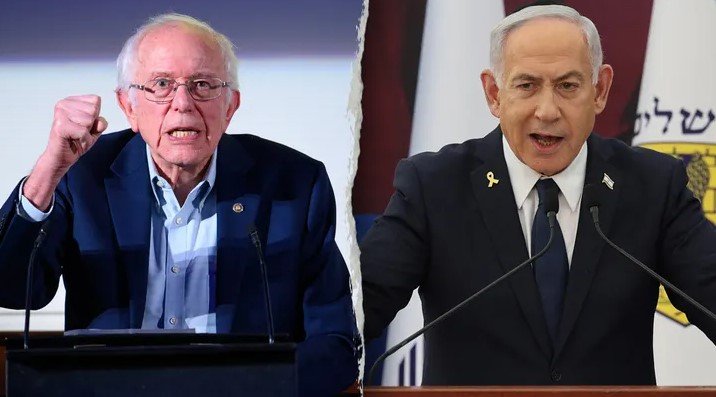
Senator introduces legislation to prevent unauthorized military action as Trump weighs intervention within two weeks
Senator Bernie Sanders has issued a scathing condemnation of Israeli Prime Minister Benjamin Netanyahu’s military actions against Iran, drawing parallels to the 2003 Iraq War and warning that the United States must not be “dragged into Netanyahu’s war of choice” . The Vermont independent’s statements come as President Donald Trump considers whether to authorize U.S. military involvement in the escalating Israel-Iran conflict within the next two weeks
Historical Parallel, Netanyahu’s Iraq War Support
Sanders has highlighted Netanyahu’s role in promoting the 2003 U.S. invasion of Iraq as evidence of the Israeli leader’s flawed judgment on military matters . In 2002 congressional testimony, Netanyahu declared there was “no question whatsoever that Saddam is seeking nuclear weapons” and guaranteed that removing Saddam Hussein’s regime would have “enormous positive reverberations on the region”
“Netanyahu was wrong. Very wrong,” Sanders stated in his recent press release . “The war in Iraq resulted in 4,492 U.S. military deaths, over 32,000 wounded, and a cost of roughly three trillion dollars. Hundreds of thousands of Iraqis also died as a result of that tragic war”
The senator emphasized that Netanyahu’s predictions about Iraq proved catastrophically incorrect, noting that the Israeli prime minister had also incorrectly forecast that the war would inspire democratic uprisings in Iran that would topple the theocratic regime
Current Crisis, Israel’s “Illegal” Attacks on Iran
The current conflict began on June 13, 2025, when Israel launched what Sanders characterized as “illegal, unilateral attacks” on Iranian nuclear facilities and military targets . The strikes have resulted in at least 224 Iranian deaths and over 1,000 wounded, according to Iranian officials, while Israeli authorities report 24 killed and hundreds injured in retaliatory attacks
Sanders accused Netanyahu of deliberately sabotaging U.S. diplomatic efforts by assassinating Ali Shamkhani, Iran’s chief nuclear negotiator, just days before scheduled nuclear talks between the United States and Iran . “This attack was specifically designed to sabotage American diplomatic efforts,” Sanders stated
Legislative Response, The No War Against Iran Act
In response to the escalating crisis, Sanders introduced the “No War Against Iran Act” on June 16, which would prohibit the use of federal funds for any U.S. military action against Iran without explicit Congressional authorization . The legislation includes exceptions only for self-defense as outlined in the War Powers Act
The bill has garnered bipartisan support, with co-sponsors including Senators Peter Welch, Elizabeth Warren, Jeff Merkley, Chris Van Hollen, Ed Markey, Tammy Baldwin, and Tina Smith . Similar resolutions have been introduced in the House by Representatives Thomas Massie (R-Ky.) and Ro Khanna (D-Calif.)
“Congress must make it clear that the United States will not be dragged into Netanyahu’s war of choice,” Sanders declared . “Our Founding Fathers entrusted the power of war and peace exclusively to the people’s elected representatives in Congress”
Constitutional and Legal Concerns
Sanders has emphasized that any U.S. military involvement in the Iran conflict without Congressional authorization would violate the Constitution . “The U.S. Constitution is crystal clear: there can be no offensive use of military force against Iran or any other country without an explicit authorization from Congress,” he stated
The senator has also characterized Netanyahu as “a war criminal under indictment by the International Criminal Court” for actions in Gaza, including the use of starvation as a method of warfare and directing attacks against civilian populations
Trump’s Deliberation and Regional Implications
President Trump announced Thursday that he would make a decision on potential U.S. military involvement within two weeks, citing “a substantial chance of negotiations that may or may not take place with Iran in the near future” . White House Press Secretary Karoline Leavitt conveyed Trump’s message that he believes there remains possibility for diplomatic resolution
European officials are hoping to use this two-week window for last-minute diplomatic breakthroughs, with high-level nuclear talks scheduled between European and Iranian officials in Geneva . However, Iranian officials have indicated they will not engage in talks with the U.S. until Israeli hostilities cease
The conflict has already drawn in regional actors, with Yemen’s Houthis launching ballistic missiles at Tel Aviv, though notably, Hezbollah and other Iranian proxies have remained largely absent due to previous Israeli military actions
Nuclear Escalation Concerns
Former Iranian nuclear negotiator Seyed Hossein Mousavian warned that Israel’s military actions may compel Iran to reconsider its nuclear weapons policy . “Iranians feel the need for nuclear deterrence, which translates to acquiring a nuclear bomb,” Mousavian stated, adding that continued military pressure would likely push Iran toward developing nuclear weapons rather than deterring them
Military analysts describe the current situation as the world’s first “threshold war” a conflict where a nuclear-capable nation uses military force to prevent an adversary from achieving nuclear capability . This dynamic creates what experts call a “commitment trap,” where both sides face escalating costs but cannot retreat without significant strategic losses
Sanders’ Warning to America
Throughout his statements, Sanders has consistently warned against American involvement in what he terms “Netanyahu’s war.” Drawing from the lessons of Iraq, Afghanistan, and other Middle Eastern conflicts, the senator argues that U.S. military intervention would likely lead to broader regional warfare with catastrophic consequences
“Another war in the Middle East could cost countless lives, waste trillions more dollars and lead to even more deaths, more conflict, and more displacement,” Sanders warned in his legislation introduction
The senator’s position reflects growing Congressional concern about executive war powers and the need for legislative authorization before military engagement, particularly given the potential for the Iran conflict to escalate into a broader regional war involving multiple nations and proxy forces
As Trump’s two-week deadline approaches, Sanders and his Congressional allies continue to press for diplomatic solutions while working to prevent unauthorized military action that could draw the United States into another costly Middle Eastern conflict
Images Copyrights https://www.foxnews.com/